Regenerative Labs & System Dynamics
A Systemic Approach to Regenerating the Biosphere
- When:
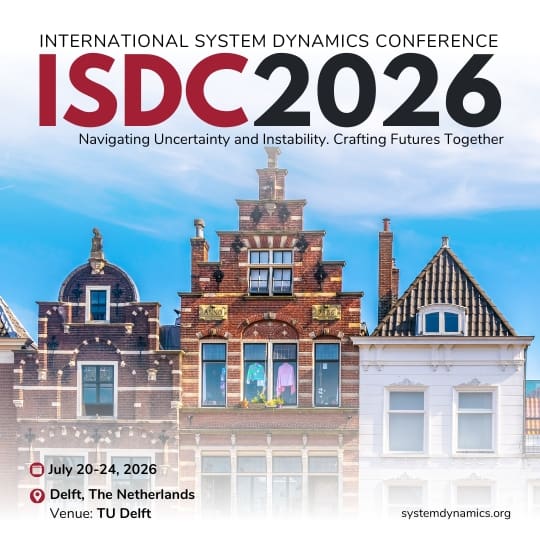
- July 20, 2026 - 13:00 - 17:00 CET
- Time:
- 13:00 - 17:00 CET
- Location:
- TU Delft, Aula Conference Center
- Suggested donation:
- FREE
Why This Conference Exists
The climate is destabilizing. Biodiversity is collapsing. Social systems are under strain. And yet the organisations meant to respond (corporations, governments, institutions) continue making decisions of generational consequence without adequate feedback loops connecting their choices to the health of the natural and social systems they depend on.
Regenerative Labs was built on one conviction: that regenerative practices and nature-based solutions are not only compatible with profitability, but they are also essential for long-term business success and planetary health. Embedding biosphere thinking directly into business decision-making is not idealism, it is the only viable operating model for organizations that intend to still be here in 30 years.
The 2026 conference fuses that mission with a powerful tool: System Dynamics – the simulation and forecasting science that allows leaders to see, in real time, the long-term consequences of their decisions.
The Speaker Lineup: Why It Matters
Prof. John Sterman: Director - MIT System Dynamics Group, MIT Sloan School of Management
Few people alive have done more to translate the complexity of our planetary crisis into something a boardroom can act on. John Sterman is the Jay W. Forrester Professor of Management at MIT, Director of the MIT System Dynamics Group, and Faculty Co-Director of the MIT Sloan Sustainability Initiative. His landmark textbook Business Dynamics: Systems Thinking and Modeling for a Complex World has been cited more than 23,000 times and remains the defining reference in the field.
At this conference, Sterman will lead a live, fully interactive session using EN-ROADS - the global climate solutions simulator he co-created with Climate Interactive. EN-ROADS simulates 100 years of energy, land-use, and climate data in under one second, enabling audiences to test real policy interventions – carbon pricing, renewable subsidies, efficiency standards – and see the results immediately. The tool has been used to brief Heads of State, bipartisan U.S. Congress members, and corporate leaders at companies including Total, Equinor, and HSBC. In 2025, the EN-ROADS team won the System Dynamics Society Applications Award, the Financial Times Responsible Business Education Award, and a Digital with Purpose Award.
For business leaders, this is not a lecture. It is a management flight simulator for the planet – and you are in the cockpit.
Jake Jacobson: MindsEye Computing (Live Demonstration)
Jacob Jacobson is a System Dynamics expert and co-developer of the New Mexico State Decarbonization Model: a validated, production-grade simulation built for real state authorities, modeling the dynamic interactions between energy policy interventions, economic variables, and environmental outcomes in real time. His work with MindsEye Computing represents the frontier of applied SD: not theoretical modeling, but decision-support infrastructure deployed by governments navigating the energy transition today.
At the conference, Jacobson will demonstrate the New Mexico model live, allowing participants to propose scenario variations in real time. For SMEs, policymakers, and business strategists, this segment answers the critical question: What does a regenerative economy decision model actually look like in practice?
Len Malczynski: MindsEye Computing / Past President, System Dynamics Society
Len Malczynski is a Simulation Scientist at MindsEye Computing, a former President of the System Dynamics Society (2017), and a faculty member at the University of New Mexico. With a career spanning Sandia National Laboratories, international development work across more than a dozen countries, and decades of modeling "wicked problems" – complex, interconnected policy challenges that resist straightforward solutions – Malczynski brings rare credibility as both a scientific practitioner and an institution-builder.
His segment makes the foundational case: System Dynamics is the missing infrastructure that regenerative leadership requires. Without simulation tools that capture feedback loops, time delays, and non-linear system behavior, even well-intentioned regenerative strategies can produce the opposite of their intended effect – a phenomenon Sterman calls "policy resistance."
Dr. Ugo Bardi — Club of Rome
Ugo Bardi is a professor at the University of Florence and a member of the Club of Rome — the institution that in 1972 commissioned The Limits to Growth, the first study to model humanity's ecological footprint using systems-based computer simulation. That report, now 50+ years old, has proven remarkably accurate: the world is in overshoot, consuming resources faster than systems can replenish them.
Bardi co-edited the 2022 follow-up report Limits and Beyond, which synthesizes what five decades of evidence have taught us – and crucially, what comes next. His message is neither doomsday nor complacency: "Collapse is not a destination, it is a process. If we manage the next decades well enough, we will be able to adapt without suffering too much." For business leaders and regulators, Bardi provides the irreplaceable planetary systems context – the hard scientific backdrop against which all regenerative strategy must be evaluated.
Sabine Oberhuber: Turntoo / Co-Author, Material Matters
Sabine Oberhuber is one of Europe's foremost circular economy pioneers and co-founder of Turntoo, a Dutch firm that has developed and implemented circular business models for some of the world's leading companies. She co-created Philips' iconic Light-as-a-Service model – in which the customer purchases lumens, not light bulbs, and the producer retains responsibility for the entire material lifecycle – and a parallel performance-based model with Bosch.
Her co-authored book Material Matters has been translated into five languages and proposes a new economic paradigm in which businesses become custodians of materials rather than consumers, and products are designed as resource banks equipped with material passports for future generations. Her perspective bridges the gap between systems thinking and actionable circular business practice — making her the essential voice for any business leader asking: "What does this actually look like in our company?"
Prof. Etiënne Rouwette: Radboud University
Etiënne Rouwette is a Professor of Methods at the Radboud University Nijmegen, and one of the world's leading researchers in Group Model Building: the participatory methodology that brings stakeholders directly into the modeling process to build shared understanding and consensus around complex problems.
His work sits at the intersection of System Dynamics, decision science, and organizational behavior, with research into how modeling tools affect participants' attitudes, cognition, and readiness to act. At this conference, Rouwette represents the bridge between rigorous simulation science and the human, organizational dimension of change, precisely the bridge that separates models that gather dust from models that reshape institutions.
Roel Kamerling: TU Delft Global Initiative
Roel Kamerling is Senior Programme Developer at the TU Delft Global Initiative, specializing in innovative public-private program development across Health, Urban, Energy, Disaster Resilience, and Entrepreneurship in low and middle income settings. His presence connects the conference's global regenerative ambition to the practical challenge of building ecosystems in their earliest, most formative stages and grounds the conversation in the TU Delft context of applied innovation.
Jan-Kees Buenen: Sustainability Leader
Jan-Kees Buenen contributes years of practice in working with big data and secure data infrastructures for actors such as the Ministry of Defence and major insurers. His systems-thinking perspective on data security, encryption, and risk is highly relevant for those engaged in questions of digital infrastructure, resilience, and public trust.
Why Business Leaders, Researchers, Regulators, and SMEs All Need to Be in the Room
This conference is deliberately and importantly cross-sector. Here is why each audience is essential:
Business Leaders need EN-ROADS and the New Mexico Decarbonization Model because their current strategic planning tools are linear – they project forward without capturing feedback loops, tipping points, or the delayed consequences of today's investment decisions. Leaders who have used EN-ROADS report that it fundamentally changes how they understand the relationship between their corporate choices and systemic outcomes. Sterman's own framing is precise: "Pilots learn to fly a new jet in simulators before going up in the real thing. Surgical teams learn to work together in medical simulations. Power plant operators learn to handle emergencies in simulators. In these settings, and for climate change, failure is not an option."
Researchers bring the modeling rigor and scientific credibility that give regenerative business strategy its evidentiary foundation. Without the connection to practitioners and decision-makers that this conference provides, models remain academic. Without models, practitioners operate on intuition in systems too complex for intuition alone.
Regulatory Officials face an acute version of the same problem. Policy decisions (on carbon pricing, land use, energy subsidies, biodiversity protection) interact in non-linear, time-delayed ways that conventional policy analysis cannot capture. System Dynamics models offer regulators the ability to stress-test policy packages before deployment, identifying unintended consequences before they become crises. The presence of European Commission representatives in the panel reflects this directly.
SMEs are both the most vulnerable to the disruption of planetary systems and at the scale of their communities and supply chains, often the most agile in responding. Oberhuber's circular economy frameworks and Jacobson's decarbonization modeling offer SMEs a practical vocabulary and a set of tools to begin their own transitions, backed by evidence from organizations that have already made the leap.
The Through-Line
Every speaker at this conference, from Sterman's climate simulations to Bardi's planetary boundaries science, from Oberhuber's material passports to Malczynski's policy modeling, from Rouwette's group decision processes to Jacobson's live decarbonization scenarios, is answering the same question from a different angle:
How do we make the long-term consequences of today's decisions on people, societies and planet impossible to ignore?
That is also the core mission of Regenerative Labs. And on 20 July 2026 at TU Delft Aula, the tools, the science, the business cases, and the decision-makers will all be in one room.
Register now and secure your place in the conversation that business can no longer afford to miss.
Speakers
- KOKai OkaforFounder, Loop Capital
Program
| Time | Segment | Lead / Contributor |
|---|---|---|
| 13:00–13:25 | The Burning Platform and The RBL: A Systemic Response | Jorge Sousa (Whatxnext) and Kenneth Rijsdijk (UvA) |
| 13:25–13:40 | Why SD is the Missing Infrastructure | Len Malczynski (MindsEye Computing) |
| 13:40-14:40 | Climate Change: Live Demo EN-ROADS | John Sterman (MIT) – interactive, audience participation |
| 14:40-15:00 | Coffee Break & Structured Networking | All participants |
| 15:00-15:30 | Voices from the Field: Challenges from the World | Sovereign representatives |
| 15:30–16:00 | Live Demo: The New Mexico Decarbonization Model | Jacob Jacobson (MindsEye) – interactive, audience participation |
| 16:00–16:30 | Panel: Building the Coalition | Moderated – SD, RBL, Policy, Business, Global South |
| 16:30–16:40 | Call to Action & Next Steps | RBL Core Team |
| 16:40–17:00 | Open Networking (Optional) | All participants |